

How Many Miles Is 10,000 Steps? (By Height, Time and Calories)
Ten thousand steps a day has become the classic fitness goal, built into almost every smartwatch and fitness app. But what does that number actually mean in real distance? So, how many miles is 10,000 steps? The answer depends mostly on your height and stride, but there is a simple rule of thumb. Here is how to figure out your exact distance, how long it takes, how many calories you burn and whether 10,000 steps is really the right goal for you.
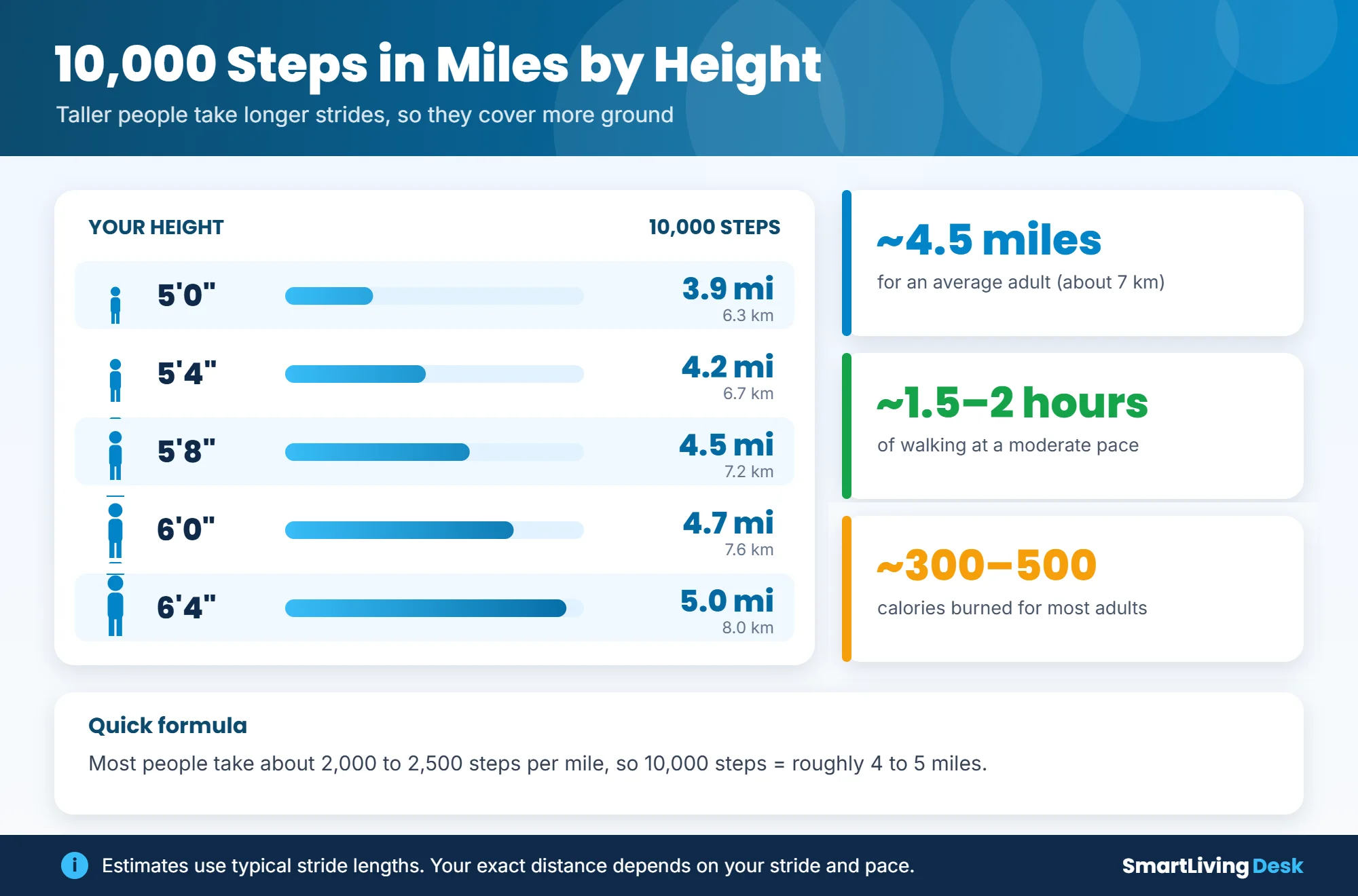
Quick answer: 10,000 steps is about 4 to 5 miles (roughly 6.5 to 8 kilometers) for most adults, with about 4.5 miles being a good average. Most people take 2,000 to 2,500 steps per mile. Walking 10,000 steps usually takes about 1.5 to 2 hours and burns roughly 300 to 500 calories, depending on your weight and pace.
How Many Miles Is 10,000 Steps?
The distance you cover depends on your stride length, the distance from one heel strike to the next. Taller people naturally take longer steps, so they need fewer steps to walk a mile. On average, most adults take about 2,000 to 2,500 steps per mile, which puts 10,000 steps at roughly 4 to 5 miles.
10,000 Steps to Miles by Height
A common way to estimate stride length is to multiply your height by about 0.41 to 0.42. Here is what that means for 10,000 steps:
| Height | Approx. stride | Steps per mile | 10,000 steps in miles | In kilometers |
|---|---|---|---|---|
| 5’0″ (152 cm) | 25 in | ~2,550 | ~3.9 miles | ~6.3 km |
| 5’4″ (163 cm) | 26.5 in | ~2,400 | ~4.2 miles | ~6.7 km |
| 5’8″ (173 cm) | 28 in | ~2,250 | ~4.5 miles | ~7.2 km |
| 6’0″ (183 cm) | 30 in | ~2,120 | ~4.7 miles | ~7.6 km |
| 6’4″ (193 cm) | 31.5 in | ~2,010 | ~5.0 miles | ~8.0 km |
Running changes the math. Running strides are much longer than walking strides, so 10,000 running steps can cover 5 to 7 miles or more.
How to measure your own stride
- Mark a starting point and walk 10 normal steps.
- Measure the total distance in inches.
- Divide by 10 to get your average stride length.
- Divide 63,360 (the number of inches in a mile) by your stride to get your steps per mile.
Many fitness trackers also let you enter your height or stride length to make their distance estimates more accurate.
How Long Does It Take to Walk 10,000 Steps?
At a moderate walking pace of around 100 steps per minute, 10,000 steps takes about 1 hour and 40 minutes. A brisk walker who covers a mile in about 15 minutes can finish in roughly 1 hour and 15 to 30 minutes. Remember that you do not need to walk all 10,000 steps at once. Everyday movement like housework, shopping and walking around the office all counts.
| Walking pace | Steps per minute | Time for 10,000 steps |
|---|---|---|
| Slow (2 mph) | ~80 | ~2 hours |
| Moderate (3 mph) | ~100 | ~1 hr 40 min |
| Brisk (3.5 to 4 mph) | ~115 to 130 | ~1 hr 15 to 25 min |
How Many Calories Does 10,000 Steps Burn?
Most adults burn roughly 30 to 50 calories per 1,000 steps, so 10,000 steps usually burns about 300 to 500 calories. Heavier people, faster walkers and those walking uphill burn more. A 130-pound person walking at an easy pace will be at the lower end, while a 200-pound person walking briskly may burn closer to 500 or more.
Is 10,000 Steps a Day Good for You?
Walking more is one of the simplest, most effective ways to improve your health. Regular walking supports heart health, helps manage weight, improves mood and sleep, and keeps joints moving. Interestingly, the 10,000 number did not come from science. It traces back to a 1960s Japanese pedometer called “manpo-kei,” which means “10,000-step meter.”
Research since then has been encouraging. A large 2022 analysis published in The Lancet Public Health found that more daily steps were linked to a lower risk of early death, with benefits leveling off at around 6,000 to 8,000 steps for adults over 60 and around 8,000 to 10,000 steps for younger adults. In other words, 10,000 is a great goal, but any increase from where you are now counts.

Easy Ways to Get 10,000 Steps a Day
- Take a 10-minute walk after each meal. That alone adds roughly 3,000 steps.
- Walk during phone calls or meetings when you can.
- Park farther away and take the stairs instead of the elevator.
- Set hourly reminders on your watch or phone to stand up and move.
- Walk with a friend or your dog to stay consistent.
- Build up gradually. If you average 4,000 steps now, try adding 1,000 steps a week, and loosen up afterward with these hip flexor stretches.
Frequently Asked Questions
How many steps are in a mile?
Most people take about 2,000 to 2,500 walking steps per mile, depending on height and stride length.
How many miles is 10,000 steps for a woman?
Because women are on average a bit shorter, 10,000 steps is usually around 4 to 4.5 miles for many women, compared with around 4.5 to 5 miles for many men. Height matters more than gender.
Will walking 10,000 steps a day help me lose weight?
It can help, since it burns about 300 to 500 extra calories a day. Weight loss also depends on your overall diet, sleep and activity, so combine walking with healthy eating for the best results.
Is 5,000 steps a day enough?
It is a good start and better than being inactive, but most research suggests health benefits keep improving up to around 7,000 to 10,000 steps for most adults.
The Bottom Line
So, how many miles is 10,000 steps? For most people, it is about 4 to 5 miles, with taller people covering more ground. It takes roughly 1.5 to 2 hours spread across your day and burns about 300 to 500 calories. Do not worry if you are not at 10,000 yet. Every extra walk counts, and building the habit is what really matters.
This article is for general information and is not medical advice. Talk to your doctor before starting a new exercise program, especially if you have a health condition.