

What Is APR? Annual Percentage Rate Explained Simply (With Examples)
Every credit card offer, car loan and personal loan comes with three letters in bold: APR. It is the single most useful number for comparing what borrowing will really cost you, yet many people are not sure what it means. So, what is APR, how is it different from an interest rate, and how much does it actually cost you each month? This guide explains it in plain English, with simple examples.
Quick answer: APR stands for annual percentage rate. It is the yearly cost of borrowing money, shown as a percentage. For loans, APR includes the interest rate plus certain fees, so it shows the true cost better than the interest rate alone. For credit cards, the APR is usually the same as the interest rate.
What Is APR?
APR, or annual percentage rate, is the price you pay each year to borrow money, expressed as a percentage of the amount you borrow. Under the federal Truth in Lending Act, US lenders must show the APR before you sign, so you can compare offers on equal terms.
Think of it like the price tag on a loan. A loan with a 7% APR costs less over a year than the same loan with a 12% APR, as long as the amount and the time period are the same. The lower the APR, the cheaper the borrowing.
APR vs. Interest Rate: What Is the Difference?
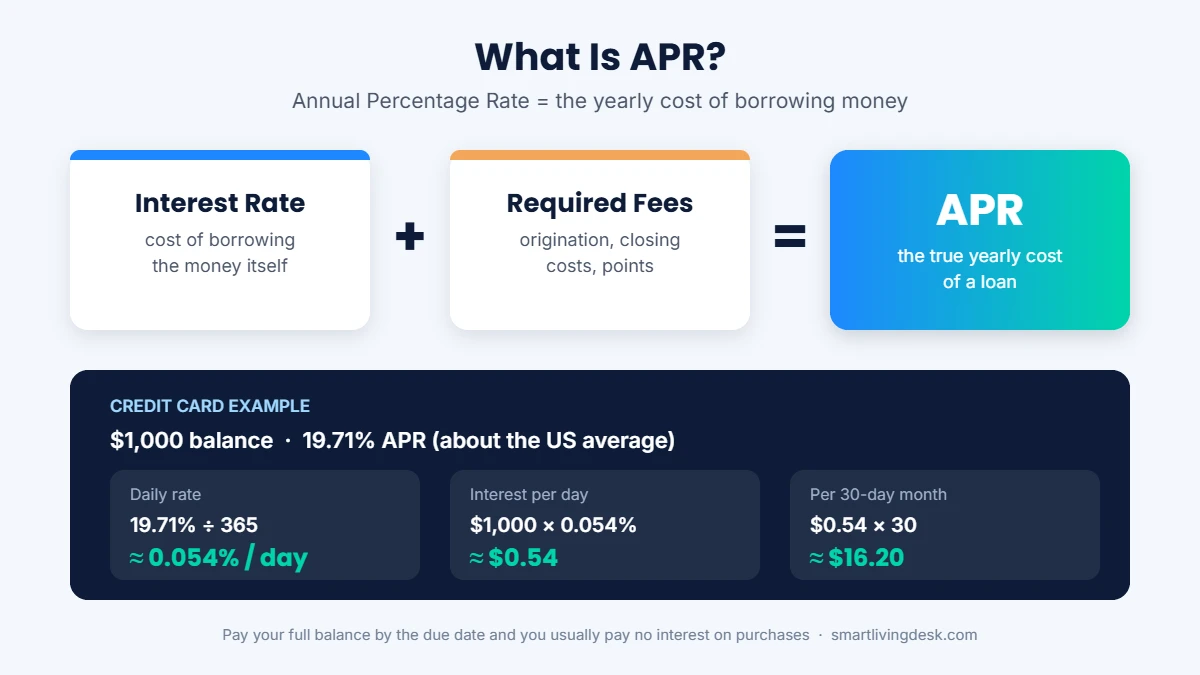
The interest rate is only the cost of borrowing the money itself. APR adds required fees on top, such as origination fees, closing costs, discount points or some mortgage insurance. That is why the APR on a mortgage or personal loan is usually a bit higher than its interest rate.
Here is a simple example. Two personal loans both charge 9% interest. Loan A has no fees. Loan B charges a 5% origination fee. Loan B will show a higher APR, which tells you right away that it costs more, even though the interest rates match.
With credit cards, there are usually no upfront borrowing fees built into the rate, so the APR and the interest rate are effectively the same number.
APR vs. APY
These two look alike but point in opposite directions. APR is what you pay to borrow. APY, or annual percentage yield, is what you earn on savings, and it includes the effect of compound interest. When you borrow, look for the lowest APR. When you save, look for the highest APY.
| APR | APY | |
|---|---|---|
| Stands for | Annual percentage rate | Annual percentage yield |
| Used for | Credit cards, loans, mortgages | Savings, CDs, money market accounts |
| Includes compounding? | No | Yes |
| You want it to be | Low | High |
Types of Credit Card APR
A single credit card can have several APRs, each for a different kind of transaction. You will find all of them in the card’s terms, usually in a table near the top.
- Purchase APR: the standard rate on things you buy with the card.
- Introductory APR: a low or 0% rate for a set time after you open the card, often 12 to 21 months.
- Balance transfer APR: the rate on debt you move over from another card. It often comes with a transfer fee.
- Cash advance APR: the rate for withdrawing cash with your card. It is usually higher than the purchase APR and has no grace period.
- Penalty APR: a much higher rate that may kick in if you pay late.
Fixed vs. Variable APR
A fixed APR stays the same for the life of the loan, which is common with mortgages, auto loans and personal loans. A variable APR moves up and down with a benchmark rate, usually the prime rate. Most credit cards have variable APRs, so your rate can change when the Federal Reserve raises or lowers interest rates.
How Credit Card Interest Is Calculated From APR
Card issuers do not charge your APR all at once. They usually turn it into a daily rate, called the daily periodic rate, by dividing the APR by 365. Then they apply it to your balance every day of the billing cycle.
Example: You carry a $1,000 balance on a card with a 19.71% APR, close to the national average in late 2026.
- Daily rate: 19.71% ÷ 365 = about 0.054% per day
- Daily interest: $1,000 × 0.054% = about $0.54
- Over a 30-day billing cycle: about $16.20 in interest
That might not sound like much, but carried for a full year it adds up to roughly $200 on just $1,000 of debt. Because most cards compound daily, the real total can be a little higher.

When APR Does Not Matter: The Grace Period
Here is the good news. Most credit cards give you a grace period, the time between the end of your billing cycle and your payment due date. If you pay your full statement balance by the due date every month, you usually pay no interest on purchases at all, no matter how high the APR is. APR only starts to matter when you carry a balance from month to month.
What Is a Good APR?
A “good” APR depends on the type of credit and your credit score. In general, a rate below the current average for that product is a good deal. For credit cards, the national average is around 20%, so anything well below that is strong. Personal loans and auto loans usually have much lower APRs than credit cards, and borrowers with excellent credit get the best rates.
How to Get a Lower APR
- Improve your credit score by paying on time and keeping balances low compared to your limits.
- Ask your card issuer. If you have a good payment history, a polite phone call can sometimes lower your rate.
- Use a 0% intro APR offer for a big purchase or balance transfer, and pay it off before the promo ends.
- Compare several lenders before you take out a loan. Prequalification usually uses a soft credit check that will not hurt your score.
- Consider a credit union. Federal credit unions cap most loan APRs at 18%.
Frequently Asked Questions
Is a 0% APR really free?
It can be, as long as you pay off the balance before the intro period ends and make every payment on time. Watch for balance transfer fees, and read the terms carefully. Some store cards use deferred interest, which can charge all the interest back if any balance is left at the end.
Does APR matter if I pay my card in full?
Not for regular purchases. If you pay the full statement balance by the due date, you generally will not be charged interest. Cash advances are the exception, since they usually start charging interest right away.
Is APR charged monthly or yearly?
APR is a yearly rate, but interest is charged in smaller pieces. Credit cards usually calculate it daily and bill it monthly. Loans usually split it across your monthly payments.
Why is my APR higher than advertised?
Advertised APRs are often a range. The rate you get depends on your credit score, income and debts. A variable APR can also rise later if benchmark interest rates go up.
The Bottom Line
So, what is APR? It is the yearly price of borrowing, including key fees, which makes it the best number for comparing loans and credit cards side by side. Keep your APR low by building good credit and shopping around, and on credit cards, sidestep it completely by paying your balance in full every month.
This article is for general educational purposes and is not financial advice. Rates and terms vary by lender, so always read your card or loan agreement and speak with a qualified professional about your situation.


