

Routing Number on a Check: Where to Find It (With Picture)
Setting up direct deposit, paying a bill online or linking a payment app? Sooner or later you will be asked for your bank’s routing number. The fastest place to find it is right on a paper check. This guide shows exactly where the routing number on a check is, how to tell it apart from your account number, and what to do if you do not have a checkbook.
Quick answer: The routing number is the first group of nine digits in the bottom-left corner of a personal check. It is usually followed by your account number and then the check number.
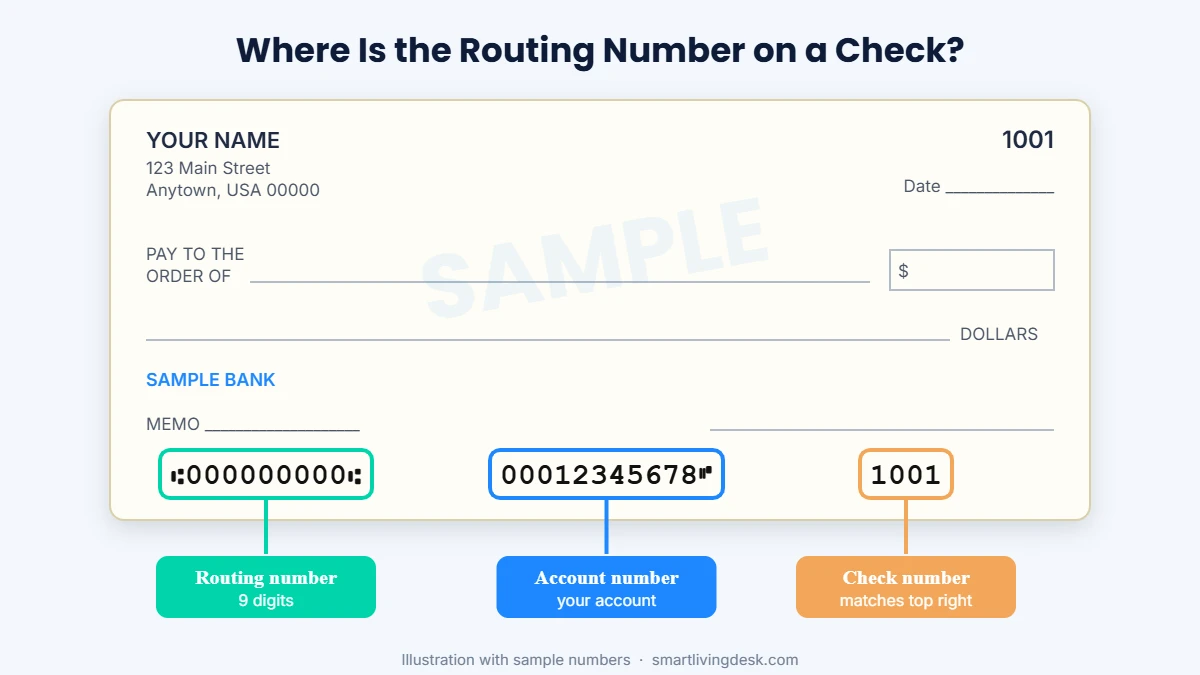
Where Is the Routing Number on a Check?
Look at the line of numbers printed along the bottom edge of the check. This strip is called the MICR line, short for Magnetic Ink Character Recognition. It is printed in a special font and magnetic ink so bank machines can read it quickly. On a standard personal check, the numbers appear in this order from left to right:
- Routing number: always nine digits, usually framed by a small symbol that looks like a vertical bar with two dots (⑆).
- Account number: the number that identifies your personal checking account. Its length varies by bank, often between 8 and 12 digits.
- Check number: a short number that matches the number printed in the top-right corner of the check.
Some business checks put the check number first, on the far left. If you are unsure, look for the group of exactly nine digits between the two ⑆ symbols. That is your routing number.
Routing Number vs. Account Number
These two numbers do different jobs, and mixing them up is one of the most common reasons a direct deposit fails.
| Routing number | Account number | |
|---|---|---|
| What it identifies | Your bank or credit union | Your individual account |
| Length | Always 9 digits | Varies, often 8 to 12 digits |
| Position on a check | First, bottom left | Second, in the middle |
| Shared with others? | Same for many customers of the bank | Unique to you |
| Sensitive? | Public information | Keep it private |
A simple way to remember it: the routing number tells the payment which bank to go to, and the account number tells it which account inside that bank.
What Do the 9 Digits Mean?
Routing numbers, also called ABA routing transit numbers, were created by the American Bankers Association in 1910. Each part of the number has a purpose:
- Digits 1 to 4: the Federal Reserve routing symbol, which points to the Federal Reserve district and processing center for the bank.
- Digits 5 to 8: the institution identifier for your specific bank or credit union.
- Digit 9: a check digit, calculated from the other eight, that helps systems catch typos.
Because of that last check digit, a single mistyped number will usually be rejected right away instead of sending your money to the wrong bank.
How to Find Your Routing Number Without a Check
Many people never order paper checks anymore. Here are the easiest alternatives:
- Your banking app or website. Most banks show the routing and account number in the account details or direct deposit section.
- A bank statement. The routing number is often printed near the top or in the account summary.
- Your bank’s official website. Large banks publish routing numbers, sometimes by state.
- A direct deposit form. Many banks let you download a pre-filled form with both numbers.
- Call or visit the bank. Customer service can confirm the right number after verifying your identity.
Can a Bank Have More Than One Routing Number?
Yes. Large national banks often use different routing numbers depending on the state where you opened your account, usually because of past mergers. Some banks also use a separate routing number for wire transfers than for ACH payments such as direct deposit and bill pay. That is why the number printed on your own check, or shown in your own account, is always the safest one to use.
One more tip: do not copy the routing number from a deposit slip. Deposit slips sometimes carry an internal number that is not the same as your account’s routing number.
When You Need Your Routing Number
- Setting up direct deposit for your paycheck
- Getting a tax refund deposited straight to your bank
- Automatic payments for loans, rent or utilities
- Transferring money between banks or linking payment apps
- Sending or receiving a wire transfer
- Ordering new checks
You generally do not need it for everyday card purchases, since debit and credit cards run on their own networks.
Is It Safe to Share Your Routing Number?
Your routing number on its own is public. Thousands of customers at the same bank share it, and it is printed on every check you write. Your account number is a different story. Together, the two numbers can be used to set up payments from your account, so only share them with employers, billers and services you trust. Watch out for unexpected calls, texts or emails asking you to “confirm” your bank details. Your bank will not ask for them that way.
Frequently Asked Questions
Is the routing number always 9 digits?
Yes. Every ABA routing number in the United States has exactly nine digits. If the number you found has more or fewer, it is probably your account number or a check number.
Is the routing number on a check the first or second number?
On personal checks, the routing number is the first set of numbers on the bottom left. The account number comes second.
Is the ACH routing number the same as the one on my check?
For most banks, yes. The number on your check is normally the one used for direct deposit and other ACH payments. Wire transfers may use a different number, so confirm with your bank before sending a wire.
Does my routing number change if I move?
No. Your routing number is tied to where and how your account was opened, not where you live now. It can change if your bank merges with another bank, in which case the bank will notify you.
The Bottom Line
The routing number on a check is the nine-digit number in the bottom-left corner, before your account number and check number. If you do not have checks, your banking app, statement or bank website will show it too. Double-check every digit before you submit a form, and keep your account number private.
This article is for general information only and is not financial advice. Always confirm banking details directly with your bank.


