

What Is a Trust Fund? How It Works, Types and Benefits
The phrase “trust fund” often brings to mind wealthy heirs, but trusts are common estate planning tools used by ordinary families too. They can help pass money to children, avoid a long court process after death and protect assets for someone who needs support. So, what is a trust fund, how does it work, and do you need one? Here is a clear, plain-English guide.
Quick answer: A trust fund is a legal arrangement where one person (the grantor) puts money or property into a trust, and a trustee manages those assets for the benefit of someone else (the beneficiary), following rules the grantor sets. Trusts can control when and how heirs receive money, help avoid probate and, in some cases, reduce taxes or protect assets.
What Is a Trust Fund?
A trust fund is a legal entity that holds assets, such as cash, stocks, real estate or a business, on behalf of one or more people or organizations. Unlike a simple gift, a trust comes with instructions. The person who sets it up decides who benefits, when they get money and what it can be used for, such as education, a first home or living costs.
The trust is created with a written document, usually drafted by an estate planning attorney, and the assets are legally moved into the trust’s name. This step is called “funding” the trust, which is where the name trust fund comes from.

How a Trust Fund Works
Every trust has three key roles:
- Grantor (also called the settlor or trustor): the person who creates the trust and puts assets into it.
- Trustee: the person or institution that manages the assets and follows the trust’s rules. Trustees have a legal “fiduciary duty” to act in the beneficiaries’ best interest.
- Beneficiary: the person, people or charity who receive the benefits.
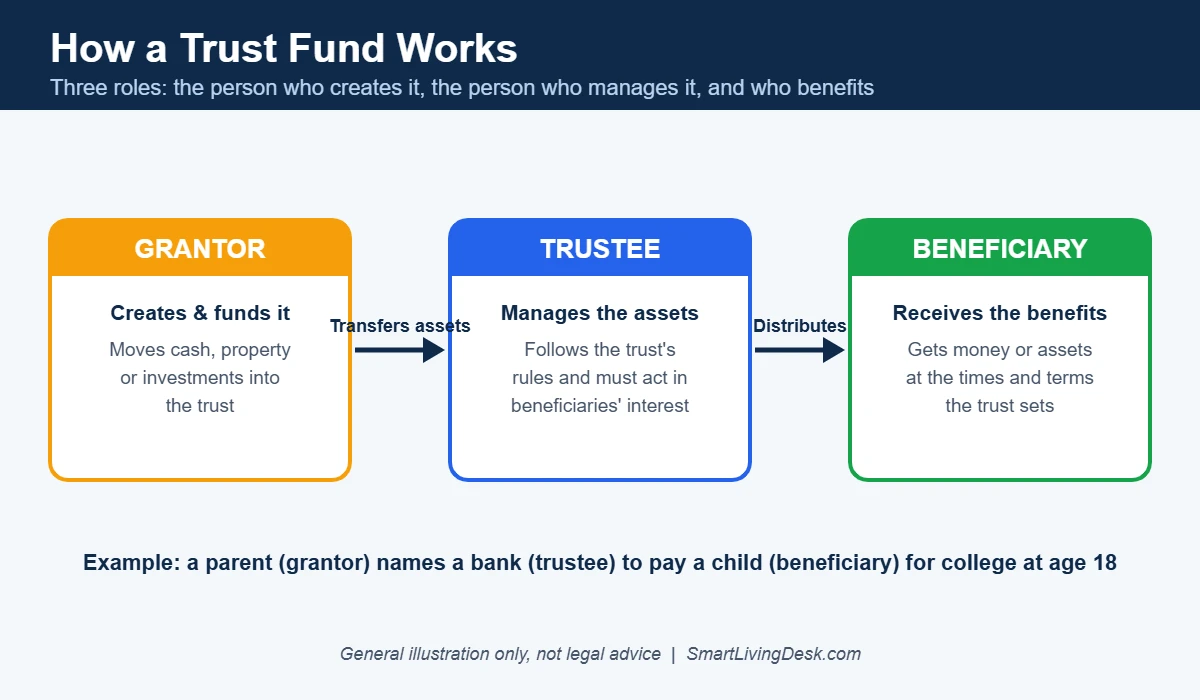
One person can hold more than one role. For example, in a common living trust, you can be the grantor, the trustee and a beneficiary while you are alive, with a successor trustee taking over when you pass away or can no longer manage your affairs.
Main Types of Trust Funds
Revocable vs. irrevocable trusts
| Revocable trust | Irrevocable trust | |
|---|---|---|
| Can you change or cancel it? | Yes, any time while you are alive and competent | Generally no, or only in limited ways |
| Who controls the assets? | You, usually as trustee | The trustee, under the trust’s terms |
| Avoids probate? | Yes, for assets placed in it | Yes, for assets placed in it |
| Protection from creditors | Little or none | Often stronger |
| Estate tax benefits | Usually none | Can remove assets from your taxable estate |
Other common types
- Living trust: created while you are alive. Most are revocable.
- Testamentary trust: created through your will and starts after death. It still goes through probate.
- Special needs trust: provides for a person with a disability without affecting eligibility for programs like Medicaid or SSI.
- Spendthrift trust: limits a beneficiary’s access to the money and protects it from their creditors.
- Charitable trust: supports a charity, often with tax benefits for the grantor.
- Education trust: sets money aside for a child’s or grandchild’s schooling.
Benefits of a Trust Fund
- Avoids probate: assets held in a trust can pass to heirs without going through probate court, which can be slow, costly and public.
- Control over timing: you can release money in stages, such as at ages 25, 30 and 35, instead of handing a lump sum to a young adult.
- Privacy: unlike a will, a trust usually does not become a public record.
- Planning for incapacity: a successor trustee can manage your money if you become ill, without a court-appointed guardian.
- Protection: some trusts shield assets from creditors, lawsuits or a beneficiary’s poor money habits.
- Possible tax savings: certain irrevocable trusts can reduce estate taxes for larger estates.
Drawbacks to Consider
Trusts are not free or effortless. Setting one up with an attorney often costs from several hundred to a few thousand dollars, and complex trusts cost more. You must also retitle assets, such as your home or bank accounts, into the trust’s name, or the trust will not control them. Irrevocable trusts mean giving up control, and trusts that hold income may face high tax rates, since trust income reaches the top federal bracket at a much lower level than individual income. Professional trustees also charge yearly fees.

Trust Fund vs. Will
A will tells a court how to distribute your property after you die and lets you name a guardian for minor children. A trust can move assets without probate and can manage money for years after your death. Many people use both: a living trust for major assets and a simple “pour-over” will that catches anything left outside the trust.
How to Set Up a Trust Fund
- Set your goals. Decide who should benefit, what they should receive and when.
- Choose the type of trust that fits those goals, revocable or irrevocable.
- Pick a trustee and a backup. This can be a trusted family member, a friend or a bank or trust company.
- Create the trust document. Online services work for simple cases, but an estate planning attorney is wise for anything complex.
- Fund the trust by moving assets into its name, such as retitling property or opening accounts in the trust’s name.
- Review it every few years and after big life events like marriage, divorce, a birth or a move to another state.
Frequently Asked Questions
Do you need to be rich to have a trust fund?
No. Many middle-income families use simple living trusts to avoid probate, keep things private and manage money for young children. Whether it is worth it depends on your assets, your state and your family situation.
Can a trust fund be used for anything?
Only what the trust document allows. The trustee must follow its rules. Some trusts allow broad use, while others limit money to health, education or basic living costs.
Are trust funds taxed?
Yes, in different ways. A revocable trust is usually taxed as part of your own income. An irrevocable trust is generally a separate taxpayer that files its own return, while income paid out to beneficiaries is often taxed to them instead. Rules are complex, so a tax professional can help.
How much money do you need to start a trust?
There is no legal minimum for a basic trust. However, some banks and trust companies only serve trusts above a certain size, and set-up costs should make sense compared with the value of your assets.
The Bottom Line
So, what is a trust fund? It is a flexible legal tool that lets you decide exactly how your money and property are managed and passed on. Whether you want to avoid probate, protect a loved one or control when your children receive an inheritance, a trust can help. Because the rules vary by state and the right setup depends on your goals, it is worth speaking with an estate planning attorney before you create one.
This article is for general educational purposes only and is not legal, tax or financial advice. Trust and estate laws vary by state, so consult a qualified estate planning attorney or tax professional about your situation.


