

How to Write a Personal Statement (Step-by-Step With Examples)
A personal statement is often the only part of an application where the reader hears from you directly. Grades and test scores show what you have done; the personal statement shows who you are and how you think. That is exactly why it feels hard to write. The good news is that a strong statement does not need dramatic life events or fancy vocabulary. It needs one honest story, told clearly, with some reflection. Here is how to write a personal statement step by step, whether you are applying to college, a UK university or graduate school.
Quick answer: To write a personal statement, read the prompt and word limit carefully, brainstorm a few meaningful experiences, and pick one focus you can explain in detail. Open with a specific moment, describe what happened, then reflect on what it taught you and how it connects to what you want to study or do next. Keep your own voice, cut anything generic, and revise several drafts before you submit.
What Is a Personal Statement?
A personal statement is a short essay that tells an admissions committee who you are beyond your grades. Depending on where you apply, it might be a broad essay about your life and values or a focused explanation of why you want to study a particular subject.
| Application | Typical length | What it focuses on |
|---|---|---|
| Common App (US colleges) | 250-650 words | A story or topic that shows your character, values or growth |
| UCAS (UK universities) | 4,000 characters total | Three questions about your subject, studies and experience |
| Graduate school | Usually 1-2 pages | Academic interests, preparation and career goals |
| Medical or law school | Set by each program | Motivation for the field, experiences and readiness |
For 2026-27, the Common App offers seven prompts with a 650-word maximum. UCAS now uses three set questions, each needing at least 350 characters, within a 4,000-character total, as explained by Talk Education. Always check the current rules for the application you are using.
How to Write a Personal Statement in 6 Steps
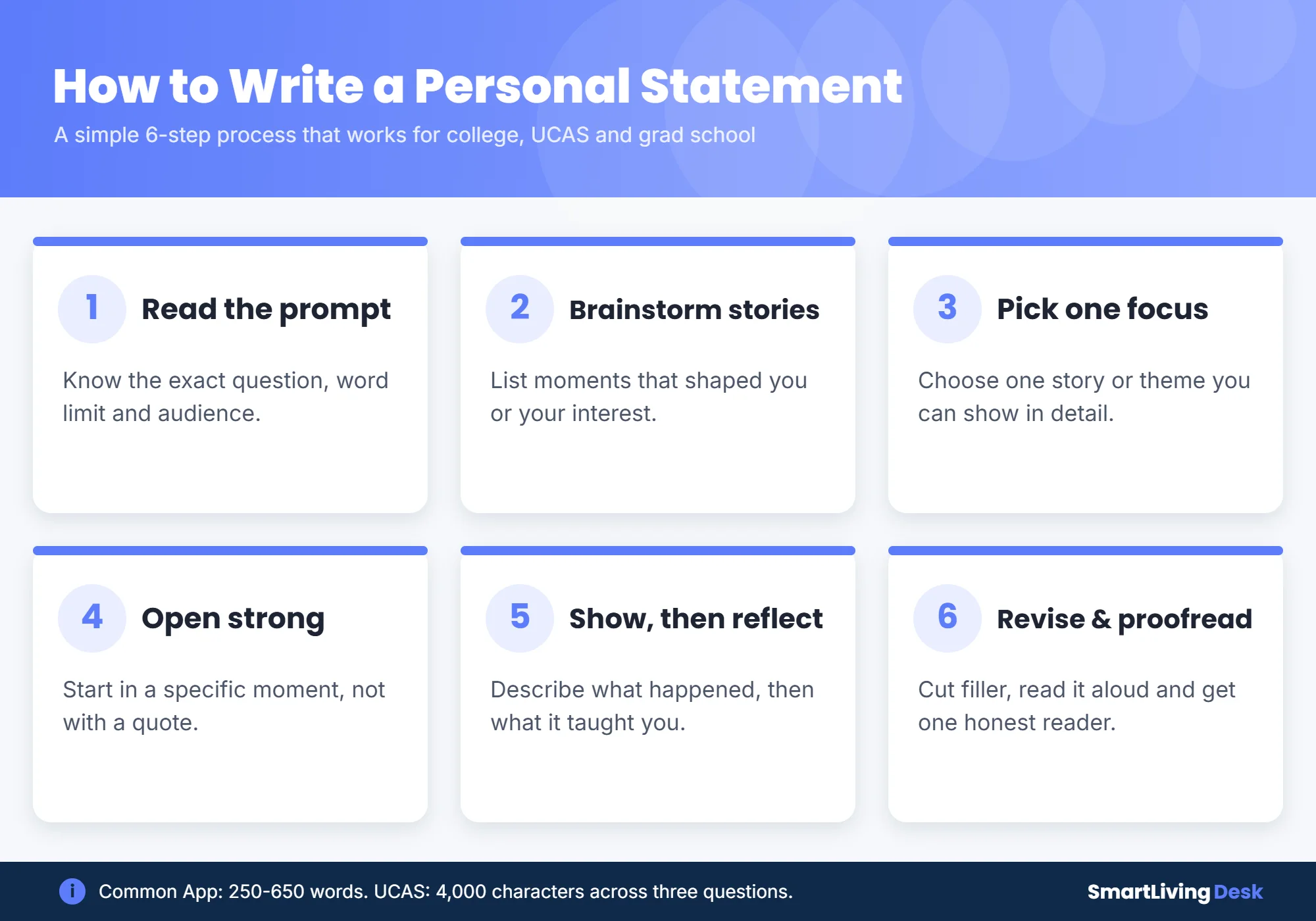
1. Read the prompt and know your limit
Before you write a word, read the prompt slowly. Underline what it actually asks. Note the word or character limit and who will read it. A college essay, a UCAS statement and a grad school statement each want something slightly different.
2. Brainstorm without judging
Spend 20 minutes listing moments, people, places and problems that matter to you. Small things count: a part-time job, a hobby you are obsessed with, a hard conversation, a project that failed. Ask yourself, “When did I change my mind about something?” and “What do I do even when no one makes me?”
3. Pick one focus
The strongest statements usually go deep on one story or theme instead of listing achievements. Choose the idea you can describe with real detail and that says something true about you. If you are writing for UCAS or grad school, make sure it connects clearly to your subject.

4. Start with a specific moment
Skip famous quotes and dictionary definitions. Drop the reader into a scene instead. Compare these two openings:
- Weak: “I have always been passionate about helping people.”
- Stronger: “The first time I fixed my neighbor’s Wi-Fi, she paid me in banana bread and asked if I could look at her printer too.”
The second one is specific, a little funny and makes the reader want to keep going.
5. Show what happened, then reflect
Spend about half your statement on the story and half on what it means. Reflection is what admissions readers look for: what you learned, how you changed, and how that shapes what you want to do next. A simple pattern is “what happened, what I did, what I learned, why it matters now.”
6. Revise, cut and proofread
Your first draft is supposed to be messy. Put it away for a day, then cut anything that sounds generic or could be written by anyone. Read it out loud to catch awkward sentences. Ask one teacher, counselor or friend for honest feedback, but keep your own voice.

How Long Should a Personal Statement Be?
Follow the exact limit you are given. As a rule of thumb, Common App essays are 250 to 650 words, UCAS statements are up to 4,000 characters (spaces included), and most graduate programs ask for one to two pages. Using most of the space shows effort, but a tight 550-word essay beats a padded 650-word one.
Personal Statement Format
- Write in the first person (“I”), in a natural, conversational but polished tone
- Use short paragraphs, each with one main idea
- No title is needed unless the application asks for one
- Avoid bullet points, headings and fancy formatting
- Write in a document first, save drafts, then paste into the application and check spacing
How to Start a Personal Statement
A good opening does one of three things: it puts the reader in a moment, it raises a question, or it shares a surprising detail. Some examples of strong first lines:
- “My grandfather kept every receipt he ever received in shoeboxes under his bed.”
- “I failed my first chemistry test by 23 points, and it was the best thing that happened to me that year.”
- “Every Saturday at 6 a.m., I am the only person at the bakery who knows how to fix the oven.”
Common Mistakes to Avoid
| Mistake | Better approach |
|---|---|
| Listing every achievement | Go deep on one story and let it show your strengths |
| Starting with a quote or definition | Start with your own specific moment |
| Writing what you think they want to hear | Write what is true for you, in your own voice |
| Too much story, no reflection | Explain what the experience taught you |
| Using big words to sound smart | Use clear, everyday language |
| Copying or using AI-written text | Write it yourself; many schools check for this |
Frequently Asked Questions
What should I not write about in a personal statement?
Avoid topics that only repeat your resume, essays that focus on someone else more than you, and stories that are too personal to share comfortably. Controversial topics are not banned, but they need careful handling.
How long does it take to write a personal statement?
Plan for several weeks. Most strong statements go through three to five drafts.
Can I use the same personal statement for different schools?
For the Common App and UCAS, one statement goes to every school you apply to. For graduate school, tailor each statement to the specific program.
Is it okay to get help with my personal statement?
Yes, feedback from teachers or counselors is normal and useful. The ideas, story and words should still be yours.
The Bottom Line
Knowing how to write a personal statement comes down to a few habits: understand the prompt, choose one honest story, open with a real moment, reflect on what it taught you and revise until every sentence earns its place. Your statement does not need to impress with drama; it needs to sound like you. For more writing help, see our guides on how to write a thank you note and how to write a memorandum.