
How to Endorse a Check (Mobile Deposit, Deposit Only and to Someone Else)
Before a bank will cash or deposit a paper check, the person it is made out to has to sign the back. That signature is called an endorsement. It takes about ten seconds, but the words you write above your name decide who can cash the check and how, so it is worth getting right.
Here is how to endorse a check for a regular deposit, a mobile deposit, or to sign it over to someone else, along with what to do with joint checks, misspelled names and checks for kids.
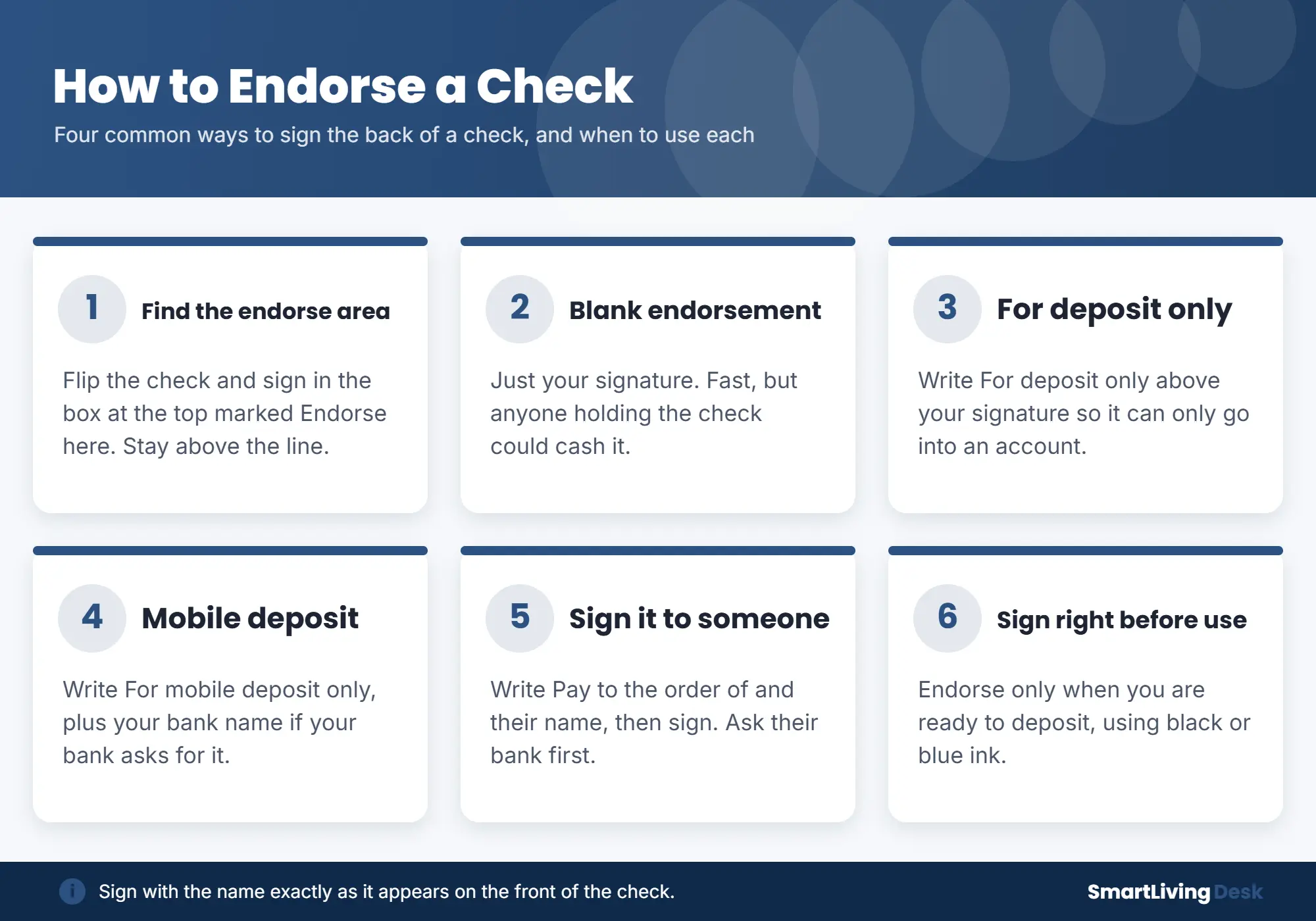
Quick answer: To endorse a check, turn it over and sign your name in the endorsement area at the top of the back, usually marked “Endorse here.” Sign the name exactly as it appears on the front. For extra safety, write “For deposit only” above your signature. For a mobile deposit, write “For mobile deposit only” (and your bank name if your bank asks). To sign a check over to someone else, write “Pay to the order of” and their name, then sign.
Where to Endorse a Check
Flip the check over so the top of the back lines up with the left end of the front. You will see a few blank lines near the top, often labeled “Endorse check here.” Below that is a line that says something like “Do not write, stamp or sign below this line.” That lower area is reserved for the bank’s processing stamps.
Keep everything you write inside the endorsement box. Experian recommends using black or dark blue ink and signing with the same name shown on the front.

The 3 Main Types of Check Endorsements
| Type | What you write | Best for |
|---|---|---|
| Blank | Your signature only | Cashing a check in person at the bank, right away |
| Restrictive | “For deposit only” + signature (account number optional) | Deposits by ATM, mail or app |
| Special (third party) | “Pay to the order of [name]” + signature | Signing a check over to another person |
Blank endorsement
This is just your signature. It is the fastest option, but Bankrate warns that a check with a blank endorsement can be cashed by anyone who gets hold of it. Only use it when you are standing at the teller window or ATM.
Restrictive endorsement (“For deposit only”)
Write “For deposit only” on the first line, then sign below it. Some people also add their account number. This means the check can only be deposited into an account, not cashed. It is the safest choice if you are depositing at an ATM, mailing the check, or leaving it in your bag until you get to the bank.
Special endorsement (signing a check to someone else)
Write “Pay to the order of” followed by the other person’s full name, then sign your own name below. That person can then deposit or cash the check. Be aware that not every bank accepts third-party checks, and some only accept them with both people present. Have the new payee call their bank first.
How to Endorse a Check for Mobile Deposit
Mobile deposit is how most people deposit checks now, and banks are strict about the endorsement. Since a 2018 update to federal check rules, many banks require a restrictive endorsement for app deposits. The most common format is:
- Your signature
- “For mobile deposit only”
- Your bank’s name (if required)
- Your account number (if required)
Check the instructions inside your bank’s app before you sign. If the endorsement is missing or wrong, the deposit can be rejected. After the deposit clears, write “Deposited” and the date on the front, and keep the paper check somewhere safe for a couple of weeks before shredding it.

How to Endorse a Check to Someone Else
- Turn the check over to the endorsement area.
- On the first line, write “Pay to the order of” and the other person’s full name.
- Sign your name underneath exactly as it appears on the front.
- Hand the check to the new payee.
- The new payee signs below your signature when they deposit or cash it.
Only sign a check over to someone you trust, and do it when you are with them, since the check becomes theirs once it is endorsed.
Special Situations
Checks made out to two people
Look at the payee line. If it says “John and Mary Smith,” both people need to sign. If it says “John or Mary Smith,” either one can endorse it alone. If it is unclear, many banks treat it as “and,” so plan on both signatures.
Your name is misspelled on the check
Sign the misspelled version first, exactly as it is written, then sign your correct name right below it. Most banks will accept this. If the name is very different from yours, ask the person who wrote the check for a new one.
Checks for a minor
A parent or guardian can usually endorse a check made out to a child. Write the child’s name, then sign your own name with a note like “parent of” or “guardian of.” Depositing it into a joint account with the child is often the easiest route. Rules vary, so ask your bank.
Business checks
A check made out to a business should be deposited into the business account. Write “For deposit only,” the business name and account number, and have an authorized person sign. Many businesses use a deposit stamp for this.
Tips to Keep Your Check Safe
- Endorse the check right before you deposit or cash it, not days ahead.
- Use a restrictive endorsement whenever you are not at the teller window.
- Check the front first: the date, the amount in words and numbers, and the payer’s signature.
- If anything is wrong or missing on the front, ask the writer for a new check instead of fixing it yourself.
- Keep mobile-deposited checks for a few weeks, then shred them.
Want to understand the front of a check too? Our guides cover how to write a check and where to find the routing number on a check.
Frequently Asked Questions
Do I have to endorse a check to deposit it?
In most cases, yes. Some banks will accept an unsigned check deposited in person into the payee’s own account, but mobile and ATM deposits almost always need an endorsement.
What happens if I sign in the wrong spot?
Writing below the “Do not write below this line” mark can interfere with processing and may cause the check to be rejected. If you made a mistake, ask your bank whether they will still take it.
Can I endorse a check with a pen color other than black or blue?
Black or dark blue ink is safest because it scans clearly. Avoid pencil, gel pens and light colors.
Can I cash a check made out to someone else?
Only if they sign it over to you with a special endorsement, and only if your bank accepts third-party checks.
Do I write my account number when I endorse a check?
It is optional for most deposits, but some banks ask for it on mobile deposits. Adding it with “For deposit only” adds a little extra protection.
The Bottom Line
Endorsing a check is simple: sign the back in the endorsement box, using the name on the front. Add “For deposit only” when you are not cashing it on the spot, “For mobile deposit only” for app deposits, or “Pay to the order of” plus a name to sign it over. Do it right before you deposit, and the check stays safe.
This article is for general information only and is not financial or legal advice. Check endorsement rules can vary by bank, so confirm the requirements with your own bank.