

How to Start a Cleaning Business (Step-by-Step Guide)
A cleaning business is one of the most popular small businesses to start, and for good reason. You can begin with a few hundred dollars in supplies, set your own hours and grow at your own pace. Demand is steady, since busy families, offices and rental hosts always need help.
Here is how to start a cleaning business step by step, including registering it, insurance, pricing, supplies and finding your first clients, plus practical advice from people who have done it, the kind shared in Reddit and Facebook groups for cleaning business owners.
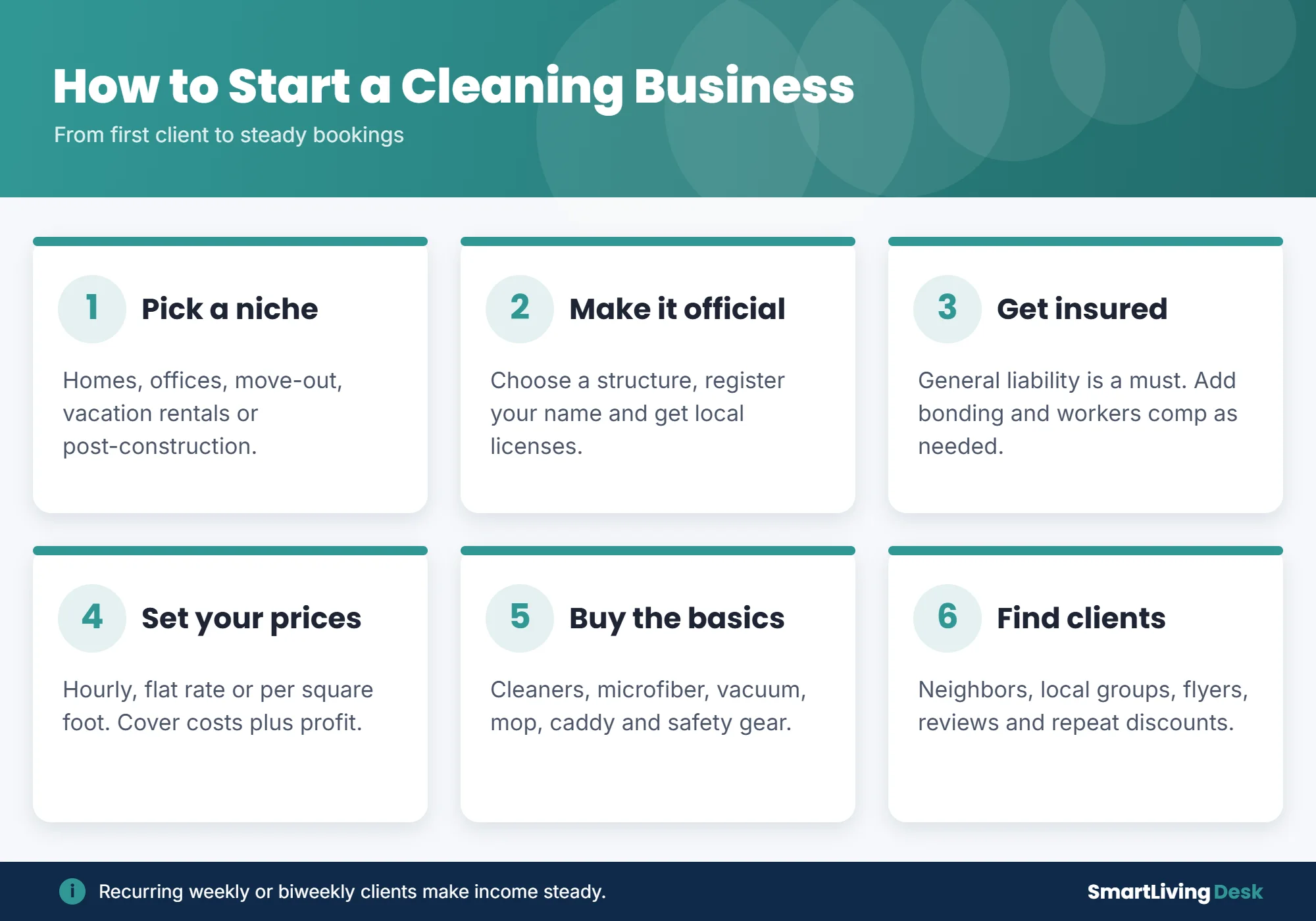
Quick answer: To start a cleaning business, choose your niche (such as homes, offices or vacation rentals), pick a business structure and register your business name, and get any local business licenses. Buy general liability insurance and consider bonding. Set your prices by the hour, by the job or by square foot, buy basic supplies, and find your first clients through neighbors, local social media groups, flyers and reviews. Focus on recurring clients for steady income.
Step 1: Choose Your Niche
- Residential cleaning: Regular house cleaning, the easiest place to start.
- Move-in and move-out cleaning: Bigger one-time jobs.
- Vacation rental turnovers: Fast cleanings between guests.
- Commercial and office cleaning: Often evening work with contracts.
- Specialty cleaning: Post-construction, carpets, windows or eco-friendly cleaning.
Stripe’s guide notes that specialized services, like post-construction or medical facility cleaning, can often charge higher rates.
Step 2: Make It Legal
- Pick a structure: Many solo cleaners start as a sole proprietorship. An LLC is popular for the personal liability protection it offers.
- Register your name: If you use a name other than your own, you may need to file a “doing business as” (DBA).
- Get an EIN: Required if you hire employees or form certain business types, and handy for banking.
- Check licenses: Many cities and counties require a general business license. The SBA licensing guide explains how to find yours.
- Open a business bank account to keep money separate.

Step 3: Get Insured
Insurance protects you if you break something in a client’s home or someone gets hurt. Stripe lists general liability, workers’ compensation (usually required once you have employees) and commercial auto insurance if you drive for work. Many residential cleaners also get a janitorial bond, which reassures clients in case of theft claims. Experienced cleaners on forums often say clients ask “Are you insured and bonded?” before anything else.
Step 4: Set Your Prices
| Pricing method | How it works | Best for |
|---|---|---|
| Hourly | Charge per hour of work | New cleaners, uncertain job sizes |
| Flat rate | Set price per visit or per room | Regular house cleaning |
| Per square foot | Price based on space size | Commercial cleaning |
To set a price, add up your costs (supplies, gas, insurance, your time), check what local competitors charge, then add a profit margin. Stripe notes commercial per-square-foot rates often fall around $0.10 to $0.50. Always be clear about what is and is not included.
Step 5: Buy Supplies and Equipment
- All-purpose cleaner, disinfectant, glass cleaner and degreaser
- Microfiber cloths, sponges and scrub brushes
- A good vacuum, mop and bucket
- Extendable duster
- Cleaning caddy
- Gloves, aprons and a basic first aid kit
- Scheduling and invoicing app

Step 6: Find Your First Clients
- Tell friends, family and neighbors.
- Post in local Facebook groups and neighborhood apps.
- Create a free Google Business Profile and ask happy clients for reviews.
- Hand out flyers and door hangers in nearby neighborhoods.
- Partner with real estate agents and property managers for move-out cleans.
- Offer a small discount for weekly or biweekly bookings.
Common Mistakes New Cleaning Businesses Make
- Underpricing to win clients, then burning out.
- Skipping insurance.
- Not using a written checklist, which leads to missed tasks and complaints.
- Not tracking mileage and expenses for taxes.
- Saying yes to every job instead of the ones that fit.
Before you launch, a simple plan helps. See our guide on how to write a business plan and how to name your business. For cleaning techniques, our home guides on ovens and grout are a good start.
Frequently Asked Questions
How much does it cost to start a cleaning business?
A solo residential cleaner can often start with a few hundred to a couple thousand dollars for supplies, insurance and registration. Costs rise with employees, vehicles and specialty equipment.
Do I need a license to start a cleaning business?
Many areas require a general business license. Specialty work, like hazardous materials cleanup, may need extra permits. Check your city and state.
Is a cleaning business profitable?
It can be, especially with recurring clients and good pricing. Profit margins depend on labor costs, travel and how efficiently you work.
Should I start as an LLC?
Many owners do for liability protection, but it is not required. Talk to an accountant about what fits your situation.
The Bottom Line
Starting a cleaning business takes a clear niche, the right paperwork, insurance, fair pricing and basic supplies. Win your first clients locally, deliver consistent work, and build a base of recurring customers for steady income.
This article is for general information and is not legal, tax or insurance advice. Licensing and insurance requirements vary by location.