

How to Become a Real Estate Agent (Steps, Cost and Timeline)
Real estate attracts a lot of career changers. You can set your own schedule, you do not need a college degree in most states, and the income potential is real. But the path is not as quick or as easy as social media sometimes makes it look, and the first year can be lean.
Here is how to become a real estate agent step by step, how long it takes, what it costs, the difference between an agent and a Realtor, and honest answers to the questions people ask on Reddit and career forums before they start.
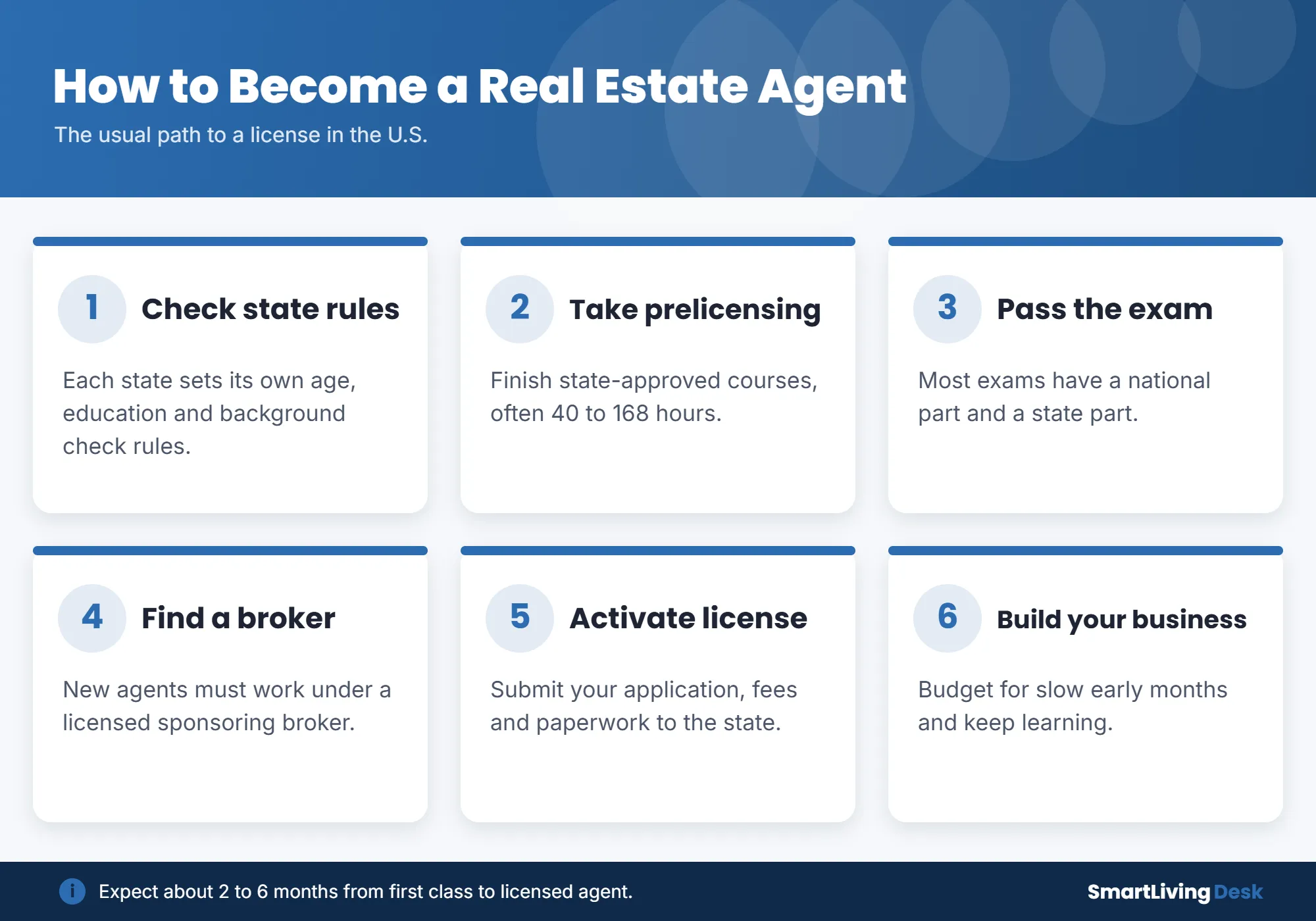
Quick answer: To become a real estate agent in the U.S., check your state’s licensing requirements, complete the required prelicensing courses (often 40 to 168 hours depending on the state), and pass your state’s real estate exam. Then join a sponsoring brokerage, submit your license application and fees, and complete any background check. Most people finish in about 2 to 6 months.
Step 1: Check Your State’s Requirements
Real estate licenses are issued by states, not the federal government, so the rules depend on where you live. Most states require you to be at least 18 or 19, have a high school diploma or equivalent, pass a background check and, in some states, submit fingerprints. Look up your state’s real estate commission website for the exact rules. You can find every state regulator through ARELLO, the association of real estate license regulators.
Step 2: Take a Prelicensing Course
According to Coursera, required prelicensing education ranges widely by state, from about 40 to 168 hours. Courses cover real estate law, contracts, property ownership, financing, agency relationships and ethics. You can take them online, at a community college or at a real estate school. Online courses are often the most flexible and affordable.

Step 3: Pass the Real Estate Exam
Most state exams have two sections: a national portion on general real estate principles and a state portion on local laws. They are multiple choice and usually taken at a testing center. If you fail one part, you can typically retake just that section after a waiting period. Practice tests help a lot.

Step 4: Find a Sponsoring Broker
New agents cannot work on their own. You must hang your license with a licensed broker who supervises your work. Coursera notes that some states require you to choose a broker before the exam, while others let you do it after. When comparing brokerages, ask about commission splits, monthly fees, training, mentorship, lead sources and office culture.
Step 5: Activate Your License
Submit your license application, exam results, broker information and fees to your state. Some states also require errors and omissions insurance. Once approved, you can start representing buyers and sellers.
Step 6: Join the Realtor Association (Optional)
“Realtor” is a trademarked title for members of the National Association of Realtors (NAR), who agree to follow its code of ethics. You do not have to join to be a licensed agent, but many brokerages require it, and membership usually gives access to the local MLS (multiple listing service).
How Long Does It Take to Become a Real Estate Agent?
Coursera estimates about 2 to 6 months, depending on your state’s hour requirements, how fast you study, exam scheduling and processing times.
How Much Does It Cost?
| Expense | What to expect |
|---|---|
| Prelicensing course | Varies widely by state and school |
| Exam fee | Charged per attempt |
| License application and background check | State fees |
| Realtor, MLS and association dues | Yearly fees if you join |
| Brokerage fees and desk fees | Depends on your brokerage |
| Marketing, signs, business cards, car costs | Ongoing |
Exact amounts depend on your state and brokerage. Many new agents underestimate ongoing costs, so budget for at least several months without steady commissions.
How Do Real Estate Agents Get Paid?
Most agents are paid on commission, not salary. When a sale closes, the commission is split between the brokerage and the agent. Income can vary a lot from year to year. The Bureau of Labor Statistics tracks pay and job outlook for real estate agents if you want current national numbers.
Is Being a Real Estate Agent Worth It?
Questions like “Is real estate worth it?” come up constantly on Reddit, and experienced agents tend to give the same honest answer: it can be very rewarding, but it is a sales business. Success comes from consistently finding clients, following up and learning the local market. Many new agents keep another job at first or save several months of expenses before starting.
Curious what your future clients need to know? Our guides on what escrow is and earnest money cover two of the most common buyer questions.
Frequently Asked Questions
Do you need a degree to become a real estate agent?
No. Most states only require a high school diploma or equivalent plus the prelicensing course and exam.
Can I become a real estate agent part time?
Yes, many people start part time. Just be aware that clients expect quick responses, and some brokerages prefer full-time agents.
Can I use my license in another state?
Not automatically. Some states have reciprocity agreements that make it easier, but you usually need to meet the other state’s requirements.
What is the difference between an agent and a broker?
A broker has more training and a higher license level and can work independently and supervise agents. Agents must work under a broker.
How hard is the real estate exam?
It is challenging but very passable with focused study and practice exams. Many people pass on the first or second try.
The Bottom Line
To become a real estate agent, check your state’s rules, complete prelicensing courses, pass the exam, join a sponsoring broker and activate your license. Plan on a few months and some upfront costs, and treat your first year like starting a small business.
Licensing rules, costs and timelines vary by state and change over time. Check with your state real estate commission for current requirements.