

How to Write a Business Plan (Step-by-Step Guide)
A business plan sounds like something only big startups need for investors. In reality, it is just a written version of the thinking you need to do anyway: who you are selling to, how you will reach them, what it will cost and how you will make money. Writing it down forces you to spot weak spots before they cost you.
This guide shows how to write a business plan step by step, which format to choose, what goes in each section, and answers to the questions small business owners ask most on Reddit and business forums.
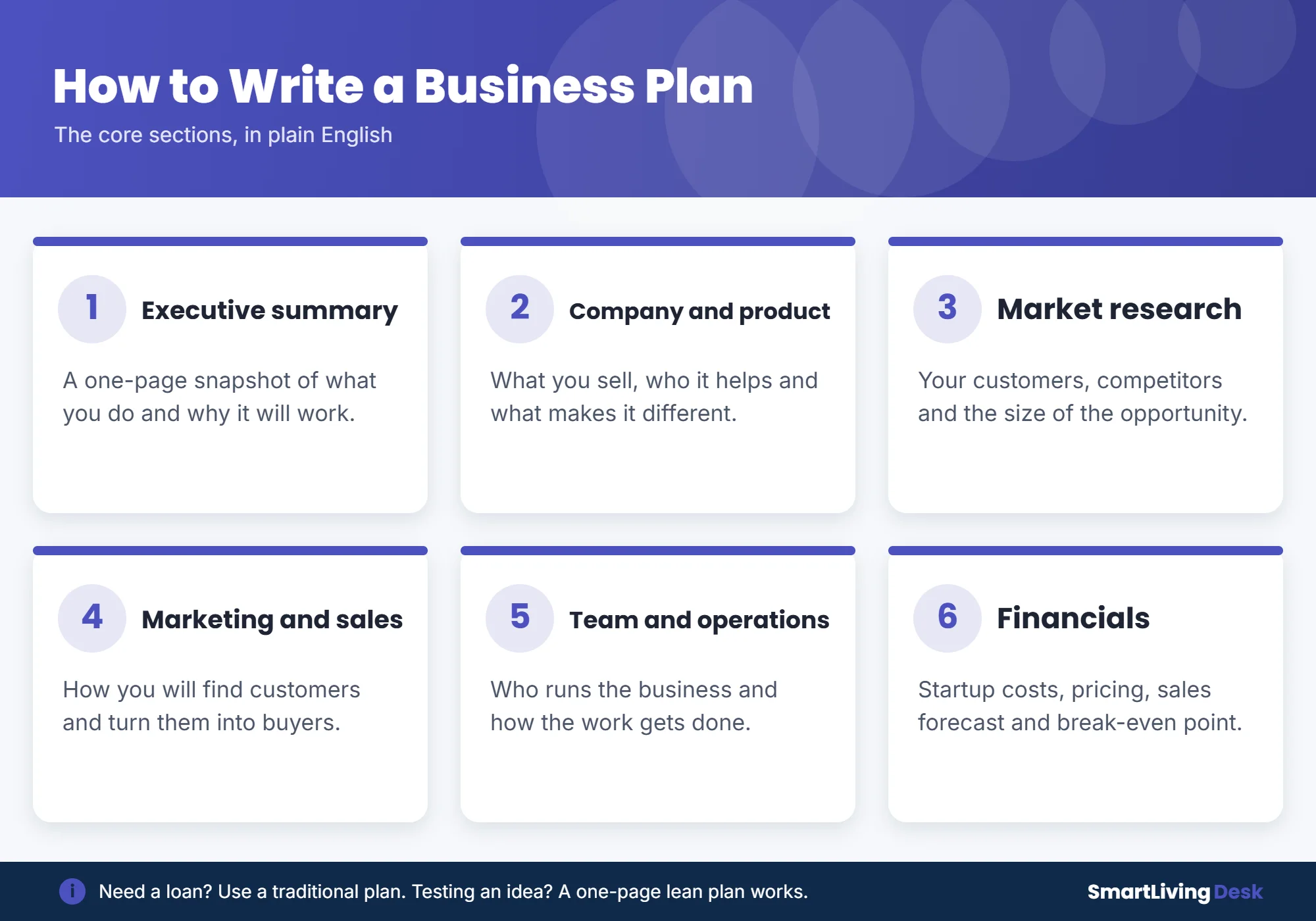
Quick answer: To write a business plan, start with your business idea, customers and goals. Then write the main sections: an executive summary, a company description, market research on your customers and competitors, your products or services, your marketing and sales plan, your team and operations, and financial projections such as startup costs, pricing and a sales forecast. Use a detailed traditional plan if you need a loan or investors, or a one-page lean plan if you are testing an idea.
Traditional vs. Lean Business Plan
According to the U.S. Small Business Administration, there is no single right format, and most plans fall into two types:
| Type | Length | Best for |
|---|---|---|
| Traditional | Several pages to 30+ | Bank loans, investors, complex businesses |
| Lean startup | Often one page | Testing an idea, launching quickly, internal planning |
The SBA also calls a business plan a living document, so expect to update it as you learn.

How to Write a Business Plan Step by Step
1. Executive summary
Write this last, but put it first. In one page, explain what your business does, who it serves, why it will succeed and, if you are seeking funding, how much you need and what it is for.
2. Company description
Describe the problem you solve, your mission, your legal structure (such as sole proprietorship or LLC), your location and what makes you different from competitors.
3. Market research
Show you understand your market. Who is your ideal customer? How many of them are there in your area? Who are your main competitors and what do they charge? Use real data where you can, plus your own research like customer surveys or checking competitors’ reviews.
4. Products or services
Explain what you sell, how it benefits customers, your pricing and anything in development. If you have suppliers, intellectual property or special processes, mention them here.
5. Marketing and sales plan
Describe how you will attract and keep customers: your brand, online presence, advertising, social media, partnerships, referrals and sales process. Include rough costs and the results you expect.
6. Management and operations
List who runs the business, their experience and roles, and any key hires you plan. Outline daily operations, equipment and suppliers.
7. Financial projections
This is the section lenders read most closely. Include startup costs, monthly expenses, a 12-month sales forecast, a basic profit and loss projection and your break-even point. If you are asking for funding, explain exactly how you will use it.
How to Write a One-Page Lean Business Plan
- Problem: What pain point are you solving?
- Solution: What do you offer?
- Customers: Who exactly will buy?
- Value proposition: Why choose you over others?
- Channels: How will you reach customers?
- Revenue: How will you make money?
- Costs: What are your main expenses?
- Key metrics: How will you measure progress?

Tips for a Strong Business Plan
- Keep it clear and concise. Plain language beats buzzwords.
- Be realistic with numbers. Lenders notice overly optimistic forecasts.
- Back up claims with data and sources.
- Tailor it to the reader, whether that is a bank, an investor or just you.
- Get feedback. The SBA points to free help from SCORE mentors and Small Business Development Centers.
Starting a service business? See our step-by-step guide on how to start a cleaning business, and our tips on how to name a business.
Frequently Asked Questions
How long should a business plan be?
A lean plan can be one page. A traditional plan for a bank loan is often 15 to 30 pages, but shorter is fine if it covers what the reader needs.
Do I really need a business plan?
If you are applying for a loan or investment, yes. Even if you are not, a simple plan helps you set goals, budget and spot problems early.
Can I write a business plan myself?
Yes. Most small business owners do. Free templates from the SBA and SCORE make it easier.
What is the most important part of a business plan?
Lenders focus on the financials and the executive summary. For you, the market research and marketing plan are often the most useful.
The Bottom Line
To write a business plan, choose a traditional or lean format, then cover your summary, company, market, offering, marketing, team and finances. Keep it honest and specific, use real numbers, and update it as your business grows.
This article is for general information and is not legal, tax or financial advice. Talk to a qualified advisor about your specific business.