

How to Ask for a Raise (With Scripts and Email Example)
Most people do not get a raise because they never ask. It feels awkward, you worry about sounding greedy, and it is easy to tell yourself your manager will notice your hard work on their own. Sometimes they do. Often they are busy, budgets are tight, and the people who make a clear case are the ones who get the increase.
Asking for a raise is a skill you can prepare for. This guide covers how to figure out what to ask for, when to bring it up, what to actually say in the meeting and in an email, and how to handle a no.
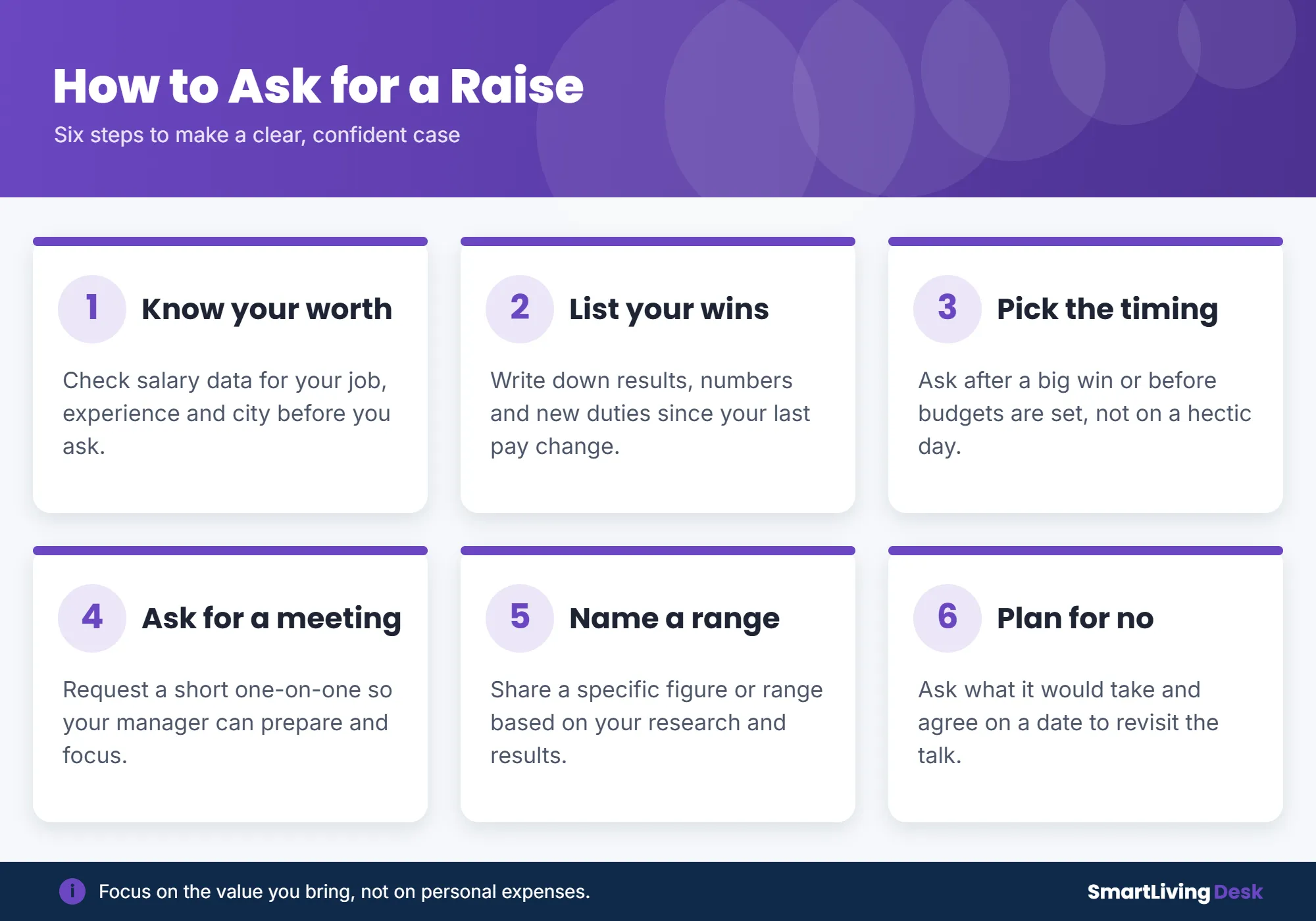
Quick answer: To ask for a raise, research what people in your role and area earn, list your specific accomplishments and added responsibilities, and pick a good time, such as after a big win or before budgets are set. Ask your manager for a short one-on-one meeting, explain the value you bring, and name a specific number or range. If the answer is no, ask what it would take to get there and agree on a date to revisit it.
Step 1: Know What You Are Worth
Before you ask for more money, you need a number. Look up pay for your job title, experience and location. Good free sources include the Bureau of Labor Statistics Occupational Outlook Handbook, salary sites like Glassdoor and Payscale, job postings that list pay ranges, and conversations with people in your field. The Harvard Program on Negotiation notes that market data showing you are underpaid gives your request real legitimacy.
Also look at your company. If it just announced layoffs or a hiring freeze, your timing may need to change, or you may want to ask for something other than salary.
Step 2: Build Your Case
Your manager has to justify any raise to someone else, so give them the reasons in writing. Write down:
- Results with numbers: sales closed, money saved, projects finished early, customer ratings.
- New responsibilities you have taken on since your last raise or since you were hired.
- Skills or certifications you have added.
- Praise from clients, coworkers or leaders.
- How long it has been since your last pay adjustment.
Focus on the value you bring to the team, not on personal reasons like rent going up. Your manager may sympathize, but business reasons are what get approved.

Step 3: Pick the Right Time
Timing can make a big difference. Good moments include:
- Shortly after you finish a big project or hit an important goal.
- A few months before annual budgets are set, when there is still room to plan for your raise.
- During or just before your performance review.
- When you have taken on a larger role but your pay has not changed.
Avoid bringing it up when your manager is stressed, right after bad company news, or in passing in the hallway.
Step 4: Ask for a Meeting
Request a dedicated one-on-one, even if it is only 20 minutes. You do not need to spell out every detail in the invite, but being upfront is respectful and gives your manager time to think. Something like: “Could we set up some time next week to talk about my role and compensation?”
Step 5: What to Say When You Ask for a Raise
Keep it calm, confident and short. Here is a simple script you can adapt:
“Thanks for making time. Over the past year I have taken on [new responsibility] and [result with a number]. I have also [another win]. Based on that and on what similar roles pay in our area, I would like to talk about adjusting my salary to [number or range]. I am really happy here and want to keep growing with the team. What do you think?”
Harvard’s Program on Negotiation points to research suggesting a range can work well, such as “Based on my contributions and market data, I was thinking in the range of 5 to 6 percent.” Put the number you actually want at the low end of your range.
Then stop talking and listen. Silence can feel uncomfortable, but give your manager room to respond.
How to Ask for a Raise in an Email
Sometimes a meeting is not possible, especially with remote teams. If you write an email, keep it brief and ask for a conversation rather than an answer on the spot:
Subject: Time to discuss my compensation
Hi [Manager],
I would like to set up a time to talk about my role and salary. Over the past year I have [key result] and taken on [new responsibility]. Based on these contributions and current market rates for this role, I would like to discuss an increase to [number or range]. Would you have 20 minutes next week?
Thanks,
[Your name]
What If the Answer Is No?
A no is not the end of the conversation. Stay professional and ask:
- “What would I need to accomplish to earn this increase?”
- “Can we set a date to revisit this, maybe in three or six months?”
- “If salary is fixed right now, is there flexibility on other things?”
Other things worth negotiating include a bonus, a title change, extra vacation days, remote work, a training budget or tuition help. Harvard’s negotiation experts note that negotiating your role and growth can matter as much for your career as the pay itself. Write down whatever you agree on and follow up by email.

Mistakes to Avoid
- Making it about personal needs. Keep the focus on results and market value.
- Comparing yourself to a coworker’s pay. Use market data instead.
- Giving an ultimatum you will not follow through on. Only mention another offer if you are truly ready to take it.
- Asking with no number in mind. A vague request is easy to postpone.
- Getting emotional or defensive. Treat it as a business conversation.
If a raise is not possible and you decide it is time to move on, our guides on how to quit a job and how to write a resignation letter can help you leave on good terms.
Frequently Asked Questions
How much of a raise should I ask for?
Base it on research. If you are paid in line with the market and doing well, a modest increase is reasonable. If you are clearly underpaid or have taken on a bigger role, a larger jump may be justified. Use salary data to back up your number.
How often can you ask for a raise?
Once a year is typical, often around your review. Asking sooner makes sense if your role has grown a lot.
Is it okay to ask for a raise after six months?
It can be, if your responsibilities have changed in a big way. Otherwise, it is usually better to wait until your first year or your review.
Should I mention another job offer?
Only if it is real and you would actually accept it. It can work, but it can also hurt trust if it feels like a bluff.
The Bottom Line
Knowing how to ask for a raise comes down to preparation. Research your market value, write down your results, choose a good moment, and ask for a specific number in a calm, one-on-one conversation. Even if the answer is not yes right away, you will leave with a clear path to get there.
This article offers general career guidance and is not legal or financial advice. Pay practices vary by employer, industry and location.