

How to Write a Check: Step-by-Step Guide With Examples
Even in the age of payment apps, paper checks are still used for rent, security deposits, gifts, contractors and some bills. If you have not written one in a while, or ever, it can feel confusing. The good news is that every check has the same six parts, and filling them in takes less than a minute. Here is exactly how to write a check, step by step, including how to write cents and how to void a check.
Quick answer: To write a check, fill in six parts: the date in the top-right corner, the payee’s name on the “Pay to the order of” line, the amount in numbers in the small box, the amount in words on the line below (with cents written as a fraction, like 50/100), an optional memo, and your signature on the bottom-right line. Always use a pen and draw a line after the name and the written amount so no one can add to them.
How to Write a Check Step by Step
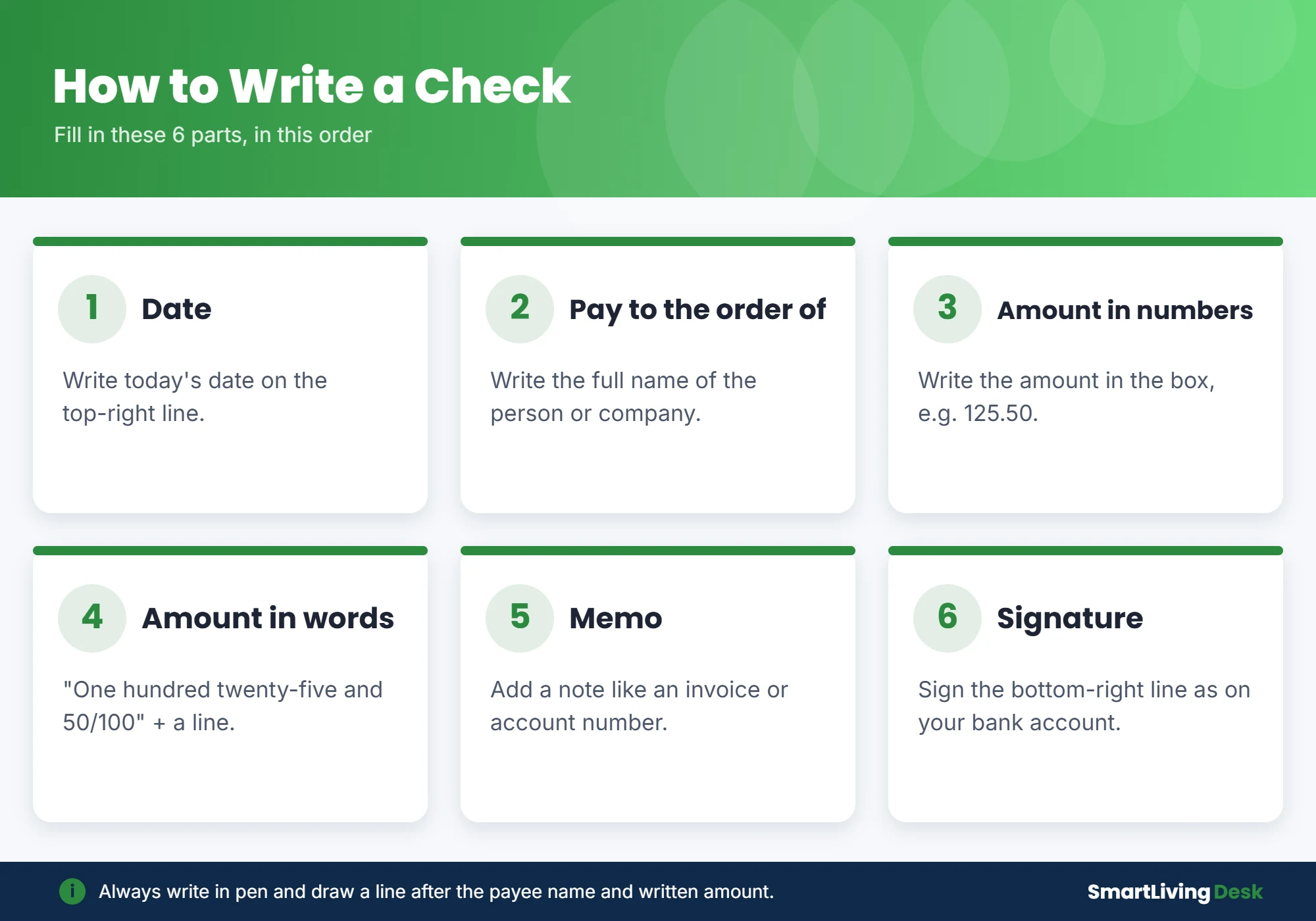
Step 1: Write the date
Write the current date on the line in the upper-right corner, such as “November 10, 2026” or “11/10/2026.” Avoid postdating a check (writing a future date), because many banks may still process it early.
Step 2: Write the payee name
On the “Pay to the order of” line, write the full name of the person or business you are paying, for example “Green Valley Apartments.” Draw a line through any empty space after the name.
Step 3: Write the amount in numbers
In the small box on the right, write the amount in numbers, such as 125.50. Start writing right next to the dollar sign so no one can add digits in front.
Step 4: Write the amount in words
On the long line below the payee, write the same amount in words, with cents written as a fraction over 100. For $125.50, write: One hundred twenty-five and 50/100. Then draw a line to the end of the space. If the numbers and words ever differ, banks generally treat the written words as the official amount.
Step 5: Fill in the memo (optional)
Use the memo line in the bottom-left corner to note what the payment is for, like “October rent” or an invoice or account number. It is optional but helps both you and the payee keep records.
Step 6: Sign the check
Sign the line in the bottom-right corner using the same signature your bank has on file. A check is not valid without a signature.

Check Writing Examples
| Amount | Box (numbers) | Written line (words) |
|---|---|---|
| $25.00 | 25.00 | Twenty-five and 00/100 |
| $125.50 | 125.50 | One hundred twenty-five and 50/100 |
| $1,000.00 | 1,000.00 | One thousand and 00/100 |
| $1,250.75 | 1,250.75 | One thousand two hundred fifty and 75/100 |
| $0.89 | 0.89 | Zero and 89/100 (or “Only 89/100”) |
How to Write a Check With Cents
Always write cents as a fraction over 100 in the written line, even when there are no cents. For example, $40 becomes “Forty and 00/100.” This makes the amount clear and harder to alter.
How to Write a Void Check
Employers often ask for a voided check to set up direct deposit. Take a blank check and write VOID in large letters across the front, covering the date, payee, amount and signature lines, but do not cover the routing and account numbers at the bottom. Learn what those numbers mean in our guide on where to find the routing number on a check.
Record the Check in Your Register

After writing a check, record the check number, date, payee and amount in your check register or banking app. This helps you track your balance and avoid overdrafts, since the money may not leave your account until the payee deposits it.
Check Writing Safety Tips
- Always use a pen, ideally with dark, permanent ink
- Never sign a blank check
- Draw lines through unused space on the payee and amount lines
- Do not make the check out to “Cash” unless necessary, since anyone can cash it
- Mail checks inside the post office or a secure mailbox
- Store your checkbook in a safe place and shred voided checks you no longer need
Frequently Asked Questions
What if I make a mistake on a check?
The safest option is to write VOID across the check and start over with a new one. Record the voided check in your register.
How do you write a check for $1,000?
Write “1,000.00” in the box and “One thousand and 00/100” on the written line, then draw a line to the end.
Can I write a check to myself?
Yes. Write your own name on the payee line, then endorse the back and deposit it. This is a common way to move money between accounts at different banks.
How long is a check good for?
Many banks may refuse personal checks older than 6 months (180 days), although they are not required to. Ask your bank about its policy.
The Bottom Line
Now you know how to write a check: date, payee, amount in numbers, amount in words with cents over 100, an optional memo and your signature. Use a pen, fill in every blank space and record the check right away. For more money basics, see our guide on what APR is.
This article is for general information only and is not financial advice. Check-handling rules can vary by bank, so contact your bank with specific questions.