

What Is Affiliate Marketing? How It Works and How to Start
If you have ever clicked a “buy” link in a product review, a YouTube description or a recipe blog, there is a good chance the person who shared it earned a small commission. That is affiliate marketing, and it is one of the most common ways websites, bloggers and social media creators make money.
Here is what affiliate marketing is, how it works, how affiliates get paid, how to get started, and the disclosure rules you need to follow.
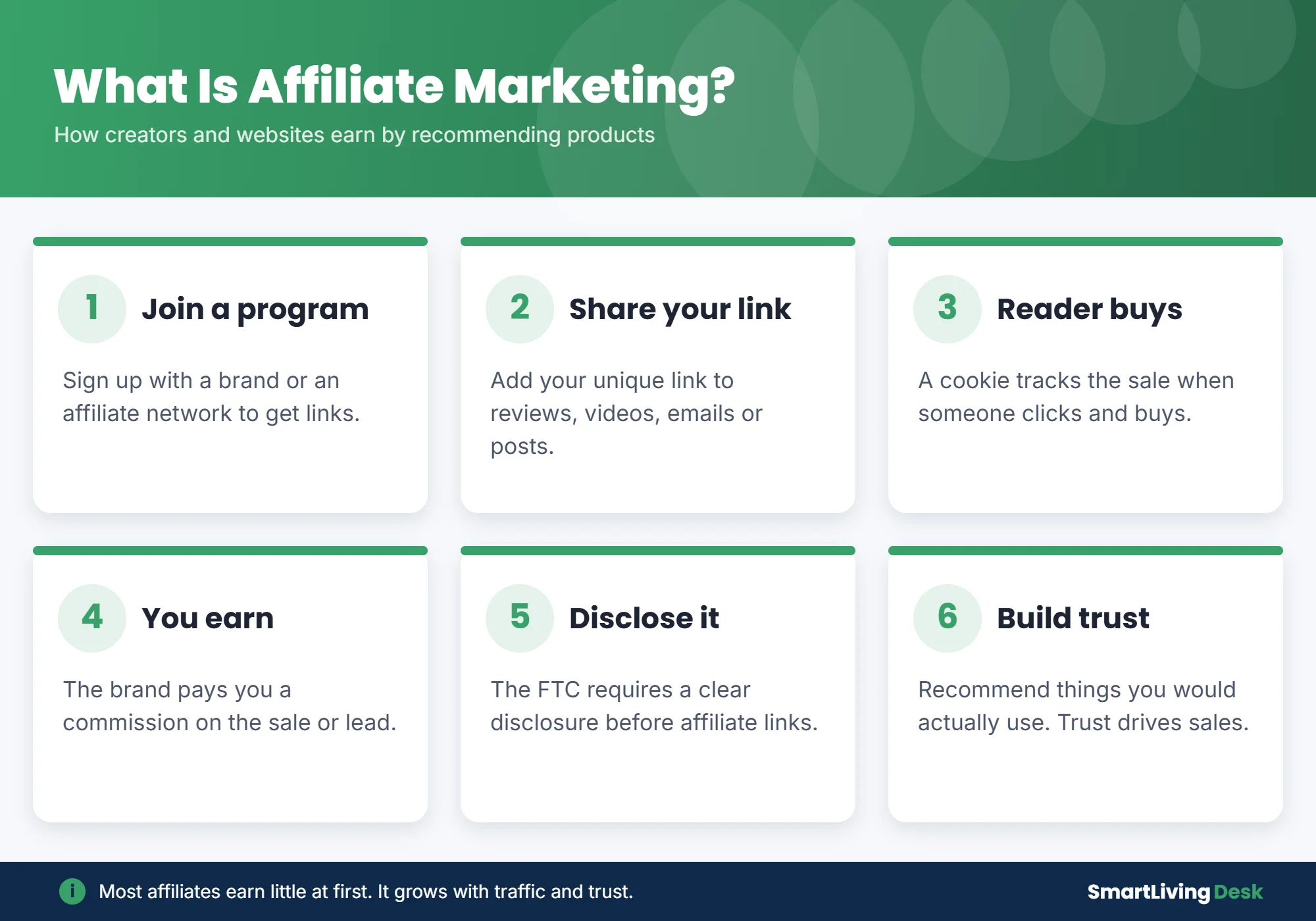
Quick answer: Affiliate marketing is a way of earning a commission by promoting another company’s products. You join an affiliate program, get a unique tracking link, and share it in your content. When someone clicks your link and makes a purchase (or signs up), the company pays you a percentage of the sale or a set fee. In the U.S., the FTC requires affiliates to clearly disclose that they may earn money from those links.
How Affiliate Marketing Works
There are usually three or four players:
- The merchant: The brand or store that sells the product.
- The affiliate: The person or website that promotes it, sometimes called a publisher or creator.
- The customer: The person who clicks the link and buys.
- The network (optional): A platform that connects merchants and affiliates and handles tracking and payments.
When a reader clicks your link, a tracking cookie or code is stored. If they buy within the program’s cookie window, which can range from a day to a few months, the sale is credited to you.

How Affiliates Get Paid
| Model | You earn when | Common in |
|---|---|---|
| Pay per sale (CPS) | A customer buys something | Retail, ecommerce |
| Pay per lead (CPL) | Someone signs up or fills out a form | Insurance, finance, software trials |
| Pay per click (CPC) | Someone clicks the link | Less common today |
| Recurring commission | A customer keeps paying monthly | Software and subscriptions |
Commission rates vary widely. Physical products often pay a few percent, while software and digital products can pay much more. Most programs have a minimum payout threshold before they send money.
Types of Affiliate Marketers
- Bloggers and review sites that write product comparisons and buying guides.
- YouTubers and social creators who share links in videos and posts.
- Email newsletter writers who recommend tools to subscribers.
- Coupon and deal sites that list discount codes.
- Comparison sites for insurance, credit cards and travel.

How to Start Affiliate Marketing
- Pick a niche you know and enjoy, such as home gear, fitness, cooking or tech.
- Choose a platform: a blog, YouTube channel, social account or email newsletter.
- Join programs: apply to brand programs you use or to large networks and retailer programs.
- Create genuinely helpful content: honest reviews, how-to guides, comparisons and lists.
- Add links naturally where they help readers decide.
- Disclose clearly every time.
- Track results and focus on what converts.
Affiliate Disclosure Rules
In the U.S., the Federal Trade Commission requires people who earn money from recommendations to disclose that relationship. As HubSpot’s affiliate guidelines summarize, the disclosure must be clear and conspicuous and appear before the affiliate link, not buried in a footer. On social media, labels like #ad can work, and in videos the disclosure should be both spoken and shown on screen. A simple example: “If you buy through links on this page, I may earn a commission.” See the FTC’s endorsement guide FAQs for details.
Pros and Cons of Affiliate Marketing
| Pros | Cons |
|---|---|
| Low startup cost | Income takes time to build |
| No product, stock or customer service | Commission rates can change |
| Can earn while you sleep | Depends on traffic from search or social |
| Flexible and remote | Too many links can hurt trust |
If you are building a website to earn this way, a strong content plan matters. Our guide on how to start a newsletter covers another popular channel for recommendations.
Frequently Asked Questions
Is affiliate marketing legit?
Yes. It is a common, legal business model used by major publishers and retailers. Be careful of courses or schemes that promise fast income.
How much do affiliate marketers make?
It ranges from nothing to a full-time income. Most beginners earn little for the first months while they build traffic.
Do I need a website to do affiliate marketing?
No, many people use YouTube, social media or email. A website does give you more control and long-term search traffic.
Do I have to pay to join affiliate programs?
Legitimate programs are free to join. Be wary of any program that asks for a fee.
The Bottom Line
Affiliate marketing means earning a commission by recommending products through tracked links. It is low-cost to start but takes time, trust and helpful content to grow. Choose a niche, join reputable programs, recommend what you believe in, and always disclose your links clearly.
This article is for general information only and is not legal, tax or financial advice. Follow the FTC’s current guidance and consult a professional for your specific situation.